Warning: Array to string conversion in /home/resallerforallot/blog.carupeshmangal.com/wp-content/themes/carupeshmangal/functions/fe/headerdata.php on line 15

Warning: Array to string conversion in /home/resallerforallot/blog.carupeshmangal.com/wp-content/themes/carupeshmangal/functions/fe/headerdata.php on line 15

Warning: Array to string conversion in /home/resallerforallot/blog.carupeshmangal.com/wp-content/themes/carupeshmangal/functions/fe/headerdata.php on line 15

Warning: Array to string conversion in /home/resallerforallot/blog.carupeshmangal.com/wp-content/themes/carupeshmangal/functions/fe/headerdata.php on line 15

Warning: Array to string conversion in /home/resallerforallot/blog.carupeshmangal.com/wp-content/themes/carupeshmangal/functions/fe/headerdata.php on line 15

Warning: Array to string conversion in /home/resallerforallot/blog.carupeshmangal.com/wp-content/themes/carupeshmangal/functions/fe/headerdata.php on line 15

Warning: Array to string conversion in /home/resallerforallot/blog.carupeshmangal.com/wp-content/themes/carupeshmangal/functions/fe/headerdata.php on line 15

Warning: Array to string conversion in /home/resallerforallot/blog.carupeshmangal.com/wp-content/themes/carupeshmangal/functions/fe/headerdata.php on line 15

Warning: Array to string conversion in /home/resallerforallot/blog.carupeshmangal.com/wp-content/themes/carupeshmangal/functions/fe/headerdata.php on line 15

Warning: Array to string conversion in /home/resallerforallot/blog.carupeshmangal.com/wp-content/themes/carupeshmangal/functions/fe/headerdata.php on line 15

Warning: Array to string conversion in /home/resallerforallot/blog.carupeshmangal.com/wp-content/themes/carupeshmangal/functions/fe/headerdata.php on line 15

Warning: Array to string conversion in /home/resallerforallot/blog.carupeshmangal.com/wp-content/themes/carupeshmangal/functions/fe/headerdata.php on line 15

Warning: Array to string conversion in /home/resallerforallot/blog.carupeshmangal.com/wp-content/themes/carupeshmangal/functions/fe/headerdata.php on line 15

Warning: Array to string conversion in /home/resallerforallot/blog.carupeshmangal.com/wp-content/themes/carupeshmangal/functions/fe/headerdata.php on line 15

Warning: Array to string conversion in /home/resallerforallot/blog.carupeshmangal.com/wp-content/themes/carupeshmangal/functions/fe/headerdata.php on line 15

Warning: Array to string conversion in /home/resallerforallot/blog.carupeshmangal.com/wp-content/themes/carupeshmangal/functions/fe/headerdata.php on line 15

Warning: Array to string conversion in /home/resallerforallot/blog.carupeshmangal.com/wp-content/themes/carupeshmangal/functions/fe/headerdata.php on line 15

Warning: Array to string conversion in /home/resallerforallot/blog.carupeshmangal.com/wp-content/themes/carupeshmangal/functions/fe/headerdata.php on line 15

Warning: Array to string conversion in /home/resallerforallot/blog.carupeshmangal.com/wp-content/themes/carupeshmangal/functions/fe/headerdata.php on line 15

Warning: Array to string conversion in /home/resallerforallot/blog.carupeshmangal.com/wp-content/themes/carupeshmangal/functions/fe/headerdata.php on line 15

Warning: Array to string conversion in /home/resallerforallot/blog.carupeshmangal.com/wp-content/themes/carupeshmangal/functions/fe/headerdata.php on line 15

Warning: Array to string conversion in /home/resallerforallot/blog.carupeshmangal.com/wp-content/themes/carupeshmangal/functions/fe/headerdata.php on line 15

Warning: Array to string conversion in /home/resallerforallot/blog.carupeshmangal.com/wp-content/themes/carupeshmangal/functions/fe/headerdata.php on line 15

Warning: Array to string conversion in /home/resallerforallot/blog.carupeshmangal.com/wp-content/themes/carupeshmangal/functions/fe/headerdata.php on line 15

Warning: Array to string conversion in /home/resallerforallot/blog.carupeshmangal.com/wp-content/themes/carupeshmangal/header.php on line 15

Warning: Array to string conversion in /home/resallerforallot/blog.carupeshmangal.com/wp-content/themes/carupeshmangal/header.php on line 15

Warning: Array to string conversion in /home/resallerforallot/blog.carupeshmangal.com/wp-content/themes/carupeshmangal/header.php on line 15

Warning: Array to string conversion in /home/resallerforallot/blog.carupeshmangal.com/wp-content/themes/carupeshmangal/header.php on line 15

Warning: Array to string conversion in /home/resallerforallot/blog.carupeshmangal.com/wp-content/themes/carupeshmangal/header.php on line 15

Warning: Array to string conversion in /home/resallerforallot/blog.carupeshmangal.com/wp-content/themes/carupeshmangal/header.php on line 15

Warning: Array to string conversion in /home/resallerforallot/blog.carupeshmangal.com/wp-content/themes/carupeshmangal/header.php on line 15

Warning: Array to string conversion in /home/resallerforallot/blog.carupeshmangal.com/wp-content/themes/carupeshmangal/header.php on line 15

Warning: Array to string conversion in /home/resallerforallot/blog.carupeshmangal.com/wp-content/themes/carupeshmangal/header.php on line 15

Warning: Array to string conversion in /home/resallerforallot/blog.carupeshmangal.com/wp-content/themes/carupeshmangal/header.php on line 15

Warning: Array to string conversion in /home/resallerforallot/blog.carupeshmangal.com/wp-content/themes/carupeshmangal/header.php on line 15

Warning: Array to string conversion in /home/resallerforallot/blog.carupeshmangal.com/wp-content/themes/carupeshmangal/header.php on line 15

Warning: Array to string conversion in /home/resallerforallot/blog.carupeshmangal.com/wp-content/themes/carupeshmangal/header.php on line 15

Warning: Array to string conversion in /home/resallerforallot/blog.carupeshmangal.com/wp-content/themes/carupeshmangal/header.php on line 15

Warning: Array to string conversion in /home/resallerforallot/blog.carupeshmangal.com/wp-content/themes/carupeshmangal/header.php on line 15

Warning: Array to string conversion in /home/resallerforallot/blog.carupeshmangal.com/wp-content/themes/carupeshmangal/header.php on line 15

Warning: Array to string conversion in /home/resallerforallot/blog.carupeshmangal.com/wp-content/themes/carupeshmangal/header.php on line 15

Warning: Array to string conversion in /home/resallerforallot/blog.carupeshmangal.com/wp-content/themes/carupeshmangal/header.php on line 15

Warning: Array to string conversion in /home/resallerforallot/blog.carupeshmangal.com/wp-content/themes/carupeshmangal/header.php on line 15

Warning: Array to string conversion in /home/resallerforallot/blog.carupeshmangal.com/wp-content/themes/carupeshmangal/header.php on line 15

Warning: Array to string conversion in /home/resallerforallot/blog.carupeshmangal.com/wp-content/themes/carupeshmangal/header.php on line 15

Warning: Array to string conversion in /home/resallerforallot/blog.carupeshmangal.com/wp-content/themes/carupeshmangal/header.php on line 15

Warning: Array to string conversion in /home/resallerforallot/blog.carupeshmangal.com/wp-content/themes/carupeshmangal/header.php on line 15

Warning: Array to string conversion in /home/resallerforallot/blog.carupeshmangal.com/wp-content/themes/carupeshmangal/header.php on line 15
Rupesh Mangal & Associates
Warning: Undefined variable $wpl_ga_code in /home/resallerforallot/blog.carupeshmangal.com/wp-content/themes/carupeshmangal/header.php on line 39

Required Documents for GST Registration

The documents required for Goods and Services Tax (GST) registration in India vary depending on the type of business entity (e.g., sole proprietorship, partnership, company). The core documents generally include a PAN card, proof of business address, identity and address proofs of key individuals, bank account details, and photographs.
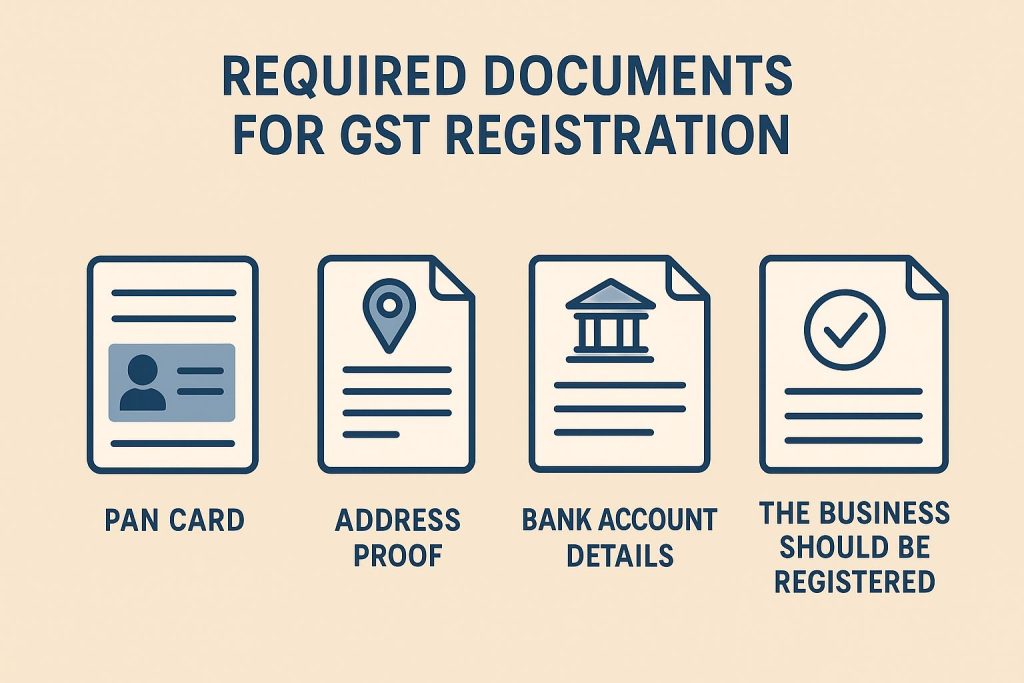
Common Required Documents (for most business types)

1.Permanent Account Number (PAN) Card of the applicant/business entity.
2.Aadhaar Card of the proprietor, partners, or authorized signatories.
3.Photographs: Passport-size photos of the owner, partners, or directors (JPEG format, max 100 KB).

4.Business Address Proof:
Owned premises: Electricity bill, property tax receipt, municipal khata copy, or ownership deed.
Rented/Leased premises: Rent/lease agreement along with an ownership document (e.g., electricity bill) of the landlord. A No Objection Certificate (NOC) from the owner might also be needed.

5.Bank Account Details: A copy of a cancelled cheque or bank statement/passbook page showing the account number, name, and IFSC code (JPEG or PDF format).
6.Proof of Appointment of Authorized Signatory: A letter of authorization or a copy of a Board Resolution for companies/LLPs.

Entity-Specific Documents

1.Sole Proprietorship: No separate legal business documents are typically needed beyond the owner’s personal documents and business proofs.
2.Partnership Firm: Partnership deed.
3.Limited Liability Partnership (LLP):
4.LLP incorporation certificate.
5.LLP Agreement.
6.Digital Signature Certificate (DSC) is mandatory.

Private/Public Limited Company:

1.Certificate of Incorporation issued by the Ministry of Corporate Affairs (MCA).
2.Memorandum of Association (MOA) and Articles of Association (AOA).
3.Board Resolution appointing an authorized signatory.
4.PAN and address proof of all directors.
5.Digital Signature Certificate (DSC) is mandatory.

Tushar Tyagi
Rupesh Mangal & Associates
CHARTERED ACCOUNTANTS

Key benefits of filing an INCOME TAX RETURN

Proof of income and address: An ITR is a valid legal document that can be used as proof of both income and address for various financial and official purposes.

Easy loan approvals: Banks and financial institutions often require ITRs to assess your financial stability and repayment capacity when you apply for a home, car, or personal loan.

Claiming tax refunds: If you have paid excess tax through Tax Deducted at Source (TDS), you can claim a refund by filing an ITR.

Carry forward losses: You can carry forward capital losses or business losses to future years to offset them against future income, but only if you file your ITR on time.

Visa processing: Many countries require copies of your ITR to assess your financial stability during the visa application process.

Avoiding penalties: Timely filing helps you avoid penalties, interest on unpaid taxes, and other legal repercussions from the income tax department.

Higher insurance coverage: Insurance companies often ask for ITR records to determine your income, which can help you get higher coverage for term insurance plans.

Business opportunities: For entrepreneurs and startups, a filed ITR demonstrates financial transparency and may be required for obtaining government tenders or securing funding from investors.

Financial transparency: Filing an ITR promotes financial transparency by documenting your income and taxes, which fosters trust with financial institutions.

Tushar Tyagi,
Rupesh Mangal & Associates
CHARTERED ACCOUNTANTS

Penalty For Late filing of GST

For late filing of Goods and Services Tax (GST) returns in India, a late fee is charged per day of delay, along with interest on any outstanding tax liability. The specific amounts vary depending on the type of return and the taxpayer’s turnover.

GSTR-1 & GSTR-3B (Normal Return) ₹50 per day (₹25 CGST + ₹25 SGST) and Maximum Late Fee annual turnover, up to 1.5 crore, then late fee 2000 (CGST + SGST) , annual turnover Between ₹1.5 Cr and ₹5 Crore then late fee 5000 (CGST + SGST), annual turnover Above ₹5 Crore, then late fee 10000 (CGST + SGST).

GSTR-1 & GSTR-3B (Nil Return) ₹20 per day (₹10 CGST + ₹10 SGST) and Maximum Late Fee ₹500 (₹250 CGST + ₹250 SGST)

GSTR-9 (Annual Return) ₹200 per day (₹100 CGST + ₹100 SGST) and Maximum Late Fee 0.5% of turnover in the State/UT (0.25% per Act)

GSTR-4 (Composition Scheme) ₹50 per day (₹20 for nil returns) and Maximum Late Fee ₹2,000 (₹500 for nil returns)

GSTR-10 (Final Return) ₹200 per day (₹100 CGST + ₹100 SGST) and Maximum Late Fee No upper limit specified

Interest on Late Payment of Tax
In addition to the late fee, interest is charged on the amount of tax that was not paid by the due date.

18% per annum on the outstanding tax liability, calculated daily from the day after the due date until the actual date of payment.
24% per annum for cases involving an undue or excess claim of Input Tax Credit (ITC) or an undue reduction in output tax liability.

Tushar Tyagi,
Rupesh Mangal & Associates
CHARTERED ACCOUNTANTS
Goods & Services exempted under GST

GST exemption applies to specific goods and services, as well as businesses based on their annual turnover. The exemptions are granted by the government, typically based on recommendations from the GST Council, to benefit the public interest

Goods exempted under GST

Essential food items: Unbranded fresh fruits, vegetables, milk, eggs, honey, salt, and flour.
Agricultural products: Fresh ginger, turmeric, and seeds for planting.
Raw materials: Unprocessed raw silk, unspun jute fiber, and raw wool.
Books and publications: Printed books, newspapers, and journals.
Medical supplies: Human blood, plasma, and contraceptives.
Handloom and handicrafts: Certain items made by specially-abled persons and traditional artisans.

Services exempted under GST

Healthcare services: Provided by clinical establishments, authorized medical practitioners, and ambulance services.
Educational services: Provided by educational institutions to students, faculty, and staff, including transportation and mid-day meal services.
Agricultural services: Labor supply for farms, warehousing of agricultural produce, and renting of agricultural machinery.
Transportation services: Public transport by metro, bus (non-AC), or auto-rickshaws. Also includes transporting specific goods like milk and newspapers.
Charitable and religious services: Religious ceremonies and services by entities registered under Section 12AA.
Government services: Provided by the Central and State Governments and local authorities, with some exceptions.

Turnover-based GST exemption

For goods: The exemption limit for annual turnover is generally ₹40 lakhs. For special category states, the limit is ₹20 lakhs.
For services: The exemption limit for annual turnover is ₹20 lakhs in most states, and ₹10 lakhs in special category states.

Tushar Tyagi,

Rupesh Mangal & Associates

CHARTERED ACCOUNTANTS
Income Tax Deductions For the A.Y. 2026-2027, (F.Y. 2025-2026)New Tax Regime Deductions

The new regime has significantly fewer deductions available compared to the old regime.
The new tax regime offers lower tax rates but limits the available deductions and exemptions.

Standard Deduction: Salaried individuals and pensioners can claim a standard deduction of ₹75,000.

Family Pension: A deduction of ₹25,000 or one-third of the pension (whichever is less) is allowed from family pension income.

Employer’s Contribution to NPS: Deduction for the employer’s contribution to a National Pension System (NPS) account is allowed up to 14% of salary (for Central/State Government employees) or 10% (for others) under Section 80CCD(2). This is outside the common Section 80C limit.

Agniveer Corpus Fund: Contributions to the Agniveer Corpus Fund under Section 80CCH are allowed as a deduction.

Most common deductions like Section 80C, 80D, HRA exemption, and interest on self-occupied house property are not available under the new regime.

Tushar Tyagi,
Rupesh Mangal & Associates
CHARTERED ACCOUNTANTS
Key Amendments to GSTR-9 for FY 2024-25

The amendments focus heavily on enhancing the transparency and reconciliation of Input Tax Credit (ITC) and aligning data better with monthly returns.

Filing Exemption Taxpayers with an aggregate annual turnover of up to ₹2 crore are exempt from filing GSTR-9.

GSTR-9C Mandate GSTR-9C (reconciliation statement) is mandatory for taxpayers with an aggregate turnover exceeding ₹5 crore.

ITC Reporting (Table 6) ITC claims are now segregated into current year credits and preceding year credits claimed in the current year using new Tables 6A1 and 6A2.

Reclaimed ITC A new Table 6H has been introduced to separately report ITC that was reversed in earlier periods (e.g., under Rule 37/37A) and subsequently reclaimed during FY 2024-25.

ITC Reversals (Table 7) Reversals must now be reported rule-wise (e.g., Rule 37, 37A, 42, 43, Section 17(5)), instead of in a consolidated manner.

Auto-Population (Table 8A) Table 8A, detailing available ITC, will auto-populate based on GSTR-2B and the document date, helping to align data with the actual financial year.

Prior Period Adjustments Tables 10, 11, 12, and 13 have undergone label changes and require more precise reporting of transactions and ITC adjustments related to FY 2024-25 but declared in subsequent returns (up to November 30, 2025).

HSN Details Reporting HSN codes in Table 17 (outward supplies) and Table 18 (inward supplies) remains mandatory, with specific digit requirements based on turnover.

Liability Payment Additional tax liability arising from reconciliation can now be settled via cash or ITC, a change from earlier rules that only allowed cash payments.

Tushar Tyagi,

Rupesh Mangal & Associates

CHARTERED ACCOUNTANTS
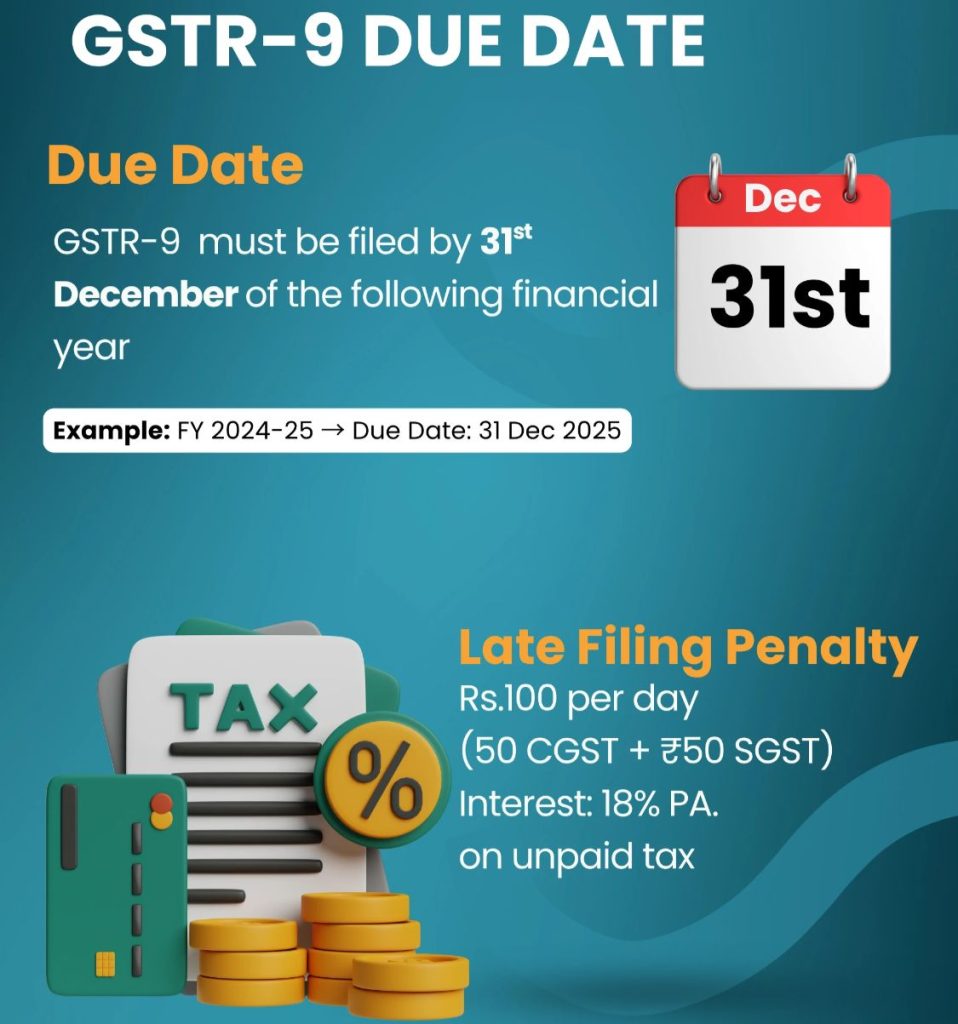
Due Date for Filing GSTR-9 for FY 2024-2025

The due date for filing the GSTR-9 (Annual Return) for the financial year (FY) 2024-25 is December 31, 2025.
This date is typically the 31st of December of the year following the end of the financial year, unless officially extended by a notification from the government.

GSTR-9: This form is mandatory for all registered regular taxpayers with an annual aggregate turnover above a certain threshold (currently ₹2 crore for FY 2024-25).

GSTR-9C: Taxpayers with an annual turnover exceeding ₹5 crore are also required to file the GSTR-9C reconciliation statement, which is due on the same date as GSTR-9 (December 31, 2025).

A.Y. 2025-2026, Of INCOME TAX REFUND DELAY ?

Delays in processing Income Tax Refunds for Assessment Year (AY) 2025-26 are primarily due to stricter verification protocols, data mismatches, and specific issues with individual returns. The Income Tax Department is conducting more rigorous scrutiny, and in some cases, refunds are withheld until the investigation or pending issues are resolved.

Common Reasons for AY 2025-26 Refund Delays

Increased Scrutiny: The IT department is conducting more detailed reviews and automated flagging of ITRs to ensure data accuracy and compliance, which slows down the overall processing time. Refunds in such cases are not processed until internal checks are complete.

Data Mismatches: Discrepancies between the information provided in your ITR and data available in Form 26AS, Annual Information Statement (AIS), or Taxpayer Information Summary (TIS) can trigger a delay and scrutiny.

Pending e-Verification: The ITR filing process is incomplete until the return is e-verified. No refund will be processed until this step is finalized.

Filing Close to the Due Date: Returns filed near the due date (September 16, 2025, for non-audit cases) experience delays due to the high volume of filings received by the department during that period.

Incorrect Bank Details: Errors in the provided bank account number or IFSC code can prevent the refund from being credited, even after processing.

💡 Smart Ways to Save Tax Under the New Tax Regime

Many believe tax planning isn’t needed under the new tax regime due to the ₹12 lakh exemption limit. But with smart financial strategies, you can still reduce your tax burden and grow your wealth—even without the traditional 80C deductions.

✅ Tax-Saving Strategies You Shouldn’t Miss

1. 💸 Standard Deduction of ₹75,000

All salaried taxpayers and pensioners can now claim a flat deduction of ₹75,000, up from the earlier ₹50,000. This automatic benefit reduces your taxable income without any paperwork.


2. 🏦 National Pension System (NPS)

  • Employer’s contribution to NPS is tax-free up to 14% of basic salary.
  • Upon retirement, 60% of the corpus is tax-free.
  • Combined NPS + EPF + Superannuation employer contributions are exempt up to ₹7.5 lakh per year.

3. 💼 Employees’ Provident Fund (EPF)

  • Employees contribute 12% of basic salary, and it’s fully tax-exempt.
  • Employer’s contribution is tax-free within the ₹7.5 lakh total cap shared with NPS.
  • Increasing your EPF contribution also boosts retirement savings.

4. 🧾 Other Work-Related Deductions

Many employer reimbursements remain tax-free, including:

  • Tea, coffee, internet, mobile bills
  • Book or journal subscriptions related to work
    These minor deductions can add up and reduce your taxable salary.

5. 🏡 Home Loan Interest on Rented Property

  • Even under the new tax regime, interest on loans for let-out property is deductible.
  • A good strategy for property investors who want to claim tax benefits.

6. 📊 Arbitrage Funds vs. Fixed Deposits (FDs)

  • Arbitrage funds enjoy lower tax rates and better post-tax returns than traditional FDs.
  • You can use gain harvesting to benefit from ₹1.25 lakh tax-free capital gains annually.

7. 👨‍💻 Section 44ADA for Freelancers

  • Professionals like consultants, designers, or CA/CS can opt for Section 44ADA.
  • Only 50% of total income is considered taxable.

Example: For ₹20 lakh gross income, tax applies to just ₹10 lakh.


🧠 Final Thought

The new tax regime doesn’t mean the end of tax planning—it simply needs a different approach. Use these strategies to reduce your tax liability and secure your financial future.


📩 Need help optimizing your tax under the new regime?
👉 Talk to an expert now

📢 ITR Due Date Extended to 15th September 2025 – What It Means for Advance Tax & Interest Liability

ITR Due Date Extension Featured

The Income Tax Department has extended the ITR filing due date for non-audit taxpayers (individuals & HUFs) from 31st July 2025 to 15th September 2025.

But this extension brings confusion — especially around interest on late tax payments. Let’s break it down simply.

🧾 What Is Advance Tax?

Advance Tax means paying your taxes in parts during the year rather than in one go at year-end. It applies to individuals with tax liability over ₹10,000 after TDS.

🧮 Who Must Pay Advance Tax?

  • Salaried persons with income from other sources (FDs, capital gains, etc.)
  • Freelancers or professionals under Section 44ADA
  • Presumptive income taxpayers under Section 44AD
  • Stock traders or capital gain earners

Senior citizens without business income are exempt.

🗓️ Advance Tax Payment Schedule (FY 2024-25)

Installment Due Date % of Tax
1st 15th June 15%
2nd 15th September 45%
3rd 15th December 75%
4th 15th March 100%

💰 What Is Self-Assessment Tax?

It’s the final tax you pay after year-end when you tally your total income and TDS. Failing to pay this on time invites interest under sections 234A, 234B, and 234C.

⚖️ Breakdown of Sections

  • Section 234A – Interest for delay in ITR filing (starts after 15th Sept 2025)
  • Section 234B – For paying less than 90% of total tax before 31st March (1% interest/month)
  • Section 234C – For late/missed advance tax installments

⚠️ Key Implications

  • ✅ No 234A interest if filed by 15th Sept 2025
  • ❌ 234B and 234C still apply if advance tax wasn’t paid correctly

✅ Summary

  • 📅 ITR due date: 15th September 2025
  • 💡 No 234A interest if filed on time
  • 🔍 234B/234C applicable as per advance tax rules

Need help calculating interest or planning advance tax? 👉 Click here for expert guidance