Warning: Array to string conversion in /home/resallerforallot/blog.carupeshmangal.com/wp-content/themes/carupeshmangal/functions/fe/headerdata.php on line 15

Warning: Array to string conversion in /home/resallerforallot/blog.carupeshmangal.com/wp-content/themes/carupeshmangal/functions/fe/headerdata.php on line 15

Warning: Array to string conversion in /home/resallerforallot/blog.carupeshmangal.com/wp-content/themes/carupeshmangal/functions/fe/headerdata.php on line 15

Warning: Array to string conversion in /home/resallerforallot/blog.carupeshmangal.com/wp-content/themes/carupeshmangal/functions/fe/headerdata.php on line 15

Warning: Array to string conversion in /home/resallerforallot/blog.carupeshmangal.com/wp-content/themes/carupeshmangal/functions/fe/headerdata.php on line 15

Warning: Array to string conversion in /home/resallerforallot/blog.carupeshmangal.com/wp-content/themes/carupeshmangal/functions/fe/headerdata.php on line 15

Warning: Array to string conversion in /home/resallerforallot/blog.carupeshmangal.com/wp-content/themes/carupeshmangal/functions/fe/headerdata.php on line 15

Warning: Array to string conversion in /home/resallerforallot/blog.carupeshmangal.com/wp-content/themes/carupeshmangal/functions/fe/headerdata.php on line 15

Warning: Array to string conversion in /home/resallerforallot/blog.carupeshmangal.com/wp-content/themes/carupeshmangal/functions/fe/headerdata.php on line 15

Warning: Array to string conversion in /home/resallerforallot/blog.carupeshmangal.com/wp-content/themes/carupeshmangal/functions/fe/headerdata.php on line 15

Warning: Array to string conversion in /home/resallerforallot/blog.carupeshmangal.com/wp-content/themes/carupeshmangal/functions/fe/headerdata.php on line 15

Warning: Array to string conversion in /home/resallerforallot/blog.carupeshmangal.com/wp-content/themes/carupeshmangal/functions/fe/headerdata.php on line 15

Warning: Array to string conversion in /home/resallerforallot/blog.carupeshmangal.com/wp-content/themes/carupeshmangal/functions/fe/headerdata.php on line 15

Warning: Array to string conversion in /home/resallerforallot/blog.carupeshmangal.com/wp-content/themes/carupeshmangal/functions/fe/headerdata.php on line 15

Warning: Array to string conversion in /home/resallerforallot/blog.carupeshmangal.com/wp-content/themes/carupeshmangal/functions/fe/headerdata.php on line 15

Warning: Array to string conversion in /home/resallerforallot/blog.carupeshmangal.com/wp-content/themes/carupeshmangal/functions/fe/headerdata.php on line 15

Warning: Array to string conversion in /home/resallerforallot/blog.carupeshmangal.com/wp-content/themes/carupeshmangal/functions/fe/headerdata.php on line 15

Warning: Array to string conversion in /home/resallerforallot/blog.carupeshmangal.com/wp-content/themes/carupeshmangal/functions/fe/headerdata.php on line 15

Warning: Array to string conversion in /home/resallerforallot/blog.carupeshmangal.com/wp-content/themes/carupeshmangal/functions/fe/headerdata.php on line 15

Warning: Array to string conversion in /home/resallerforallot/blog.carupeshmangal.com/wp-content/themes/carupeshmangal/functions/fe/headerdata.php on line 15

Warning: Array to string conversion in /home/resallerforallot/blog.carupeshmangal.com/wp-content/themes/carupeshmangal/functions/fe/headerdata.php on line 15

Warning: Array to string conversion in /home/resallerforallot/blog.carupeshmangal.com/wp-content/themes/carupeshmangal/functions/fe/headerdata.php on line 15

Warning: Array to string conversion in /home/resallerforallot/blog.carupeshmangal.com/wp-content/themes/carupeshmangal/functions/fe/headerdata.php on line 15

Warning: Array to string conversion in /home/resallerforallot/blog.carupeshmangal.com/wp-content/themes/carupeshmangal/functions/fe/headerdata.php on line 15

Warning: Array to string conversion in /home/resallerforallot/blog.carupeshmangal.com/wp-content/themes/carupeshmangal/header.php on line 15

Warning: Array to string conversion in /home/resallerforallot/blog.carupeshmangal.com/wp-content/themes/carupeshmangal/header.php on line 15

Warning: Array to string conversion in /home/resallerforallot/blog.carupeshmangal.com/wp-content/themes/carupeshmangal/header.php on line 15

Warning: Array to string conversion in /home/resallerforallot/blog.carupeshmangal.com/wp-content/themes/carupeshmangal/header.php on line 15

Warning: Array to string conversion in /home/resallerforallot/blog.carupeshmangal.com/wp-content/themes/carupeshmangal/header.php on line 15

Warning: Array to string conversion in /home/resallerforallot/blog.carupeshmangal.com/wp-content/themes/carupeshmangal/header.php on line 15

Warning: Array to string conversion in /home/resallerforallot/blog.carupeshmangal.com/wp-content/themes/carupeshmangal/header.php on line 15

Warning: Array to string conversion in /home/resallerforallot/blog.carupeshmangal.com/wp-content/themes/carupeshmangal/header.php on line 15

Warning: Array to string conversion in /home/resallerforallot/blog.carupeshmangal.com/wp-content/themes/carupeshmangal/header.php on line 15

Warning: Array to string conversion in /home/resallerforallot/blog.carupeshmangal.com/wp-content/themes/carupeshmangal/header.php on line 15

Warning: Array to string conversion in /home/resallerforallot/blog.carupeshmangal.com/wp-content/themes/carupeshmangal/header.php on line 15

Warning: Array to string conversion in /home/resallerforallot/blog.carupeshmangal.com/wp-content/themes/carupeshmangal/header.php on line 15

Warning: Array to string conversion in /home/resallerforallot/blog.carupeshmangal.com/wp-content/themes/carupeshmangal/header.php on line 15

Warning: Array to string conversion in /home/resallerforallot/blog.carupeshmangal.com/wp-content/themes/carupeshmangal/header.php on line 15

Warning: Array to string conversion in /home/resallerforallot/blog.carupeshmangal.com/wp-content/themes/carupeshmangal/header.php on line 15

Warning: Array to string conversion in /home/resallerforallot/blog.carupeshmangal.com/wp-content/themes/carupeshmangal/header.php on line 15

Warning: Array to string conversion in /home/resallerforallot/blog.carupeshmangal.com/wp-content/themes/carupeshmangal/header.php on line 15

Warning: Array to string conversion in /home/resallerforallot/blog.carupeshmangal.com/wp-content/themes/carupeshmangal/header.php on line 15

Warning: Array to string conversion in /home/resallerforallot/blog.carupeshmangal.com/wp-content/themes/carupeshmangal/header.php on line 15

Warning: Array to string conversion in /home/resallerforallot/blog.carupeshmangal.com/wp-content/themes/carupeshmangal/header.php on line 15

Warning: Array to string conversion in /home/resallerforallot/blog.carupeshmangal.com/wp-content/themes/carupeshmangal/header.php on line 15

Warning: Array to string conversion in /home/resallerforallot/blog.carupeshmangal.com/wp-content/themes/carupeshmangal/header.php on line 15

Warning: Array to string conversion in /home/resallerforallot/blog.carupeshmangal.com/wp-content/themes/carupeshmangal/header.php on line 15

Warning: Array to string conversion in /home/resallerforallot/blog.carupeshmangal.com/wp-content/themes/carupeshmangal/header.php on line 15
Rupesh Mangal & Associates
Warning: Undefined variable $wpl_ga_code in /home/resallerforallot/blog.carupeshmangal.com/wp-content/themes/carupeshmangal/header.php on line 39

Do You Need to File ITR Even if Your Income is Below the Taxable Limit?

Many taxpayers believe that if their income is below the basic exemption limit, they don’t need to file an Income Tax Return (ITR). While this is generally true, there are specific circumstances under which filing ITR becomes mandatory – even if your income is not taxable.

Here’s a clear breakdown:


✅ Minimum Income Threshold for Mandatory ITR Filing

Before looking at special circumstances, let’s recall the basic exemption limits:

  • Individuals below 60 years: ₹2.5 lakh
  • Senior Citizens (60–79 years): ₹3 lakh
  • Super Senior Citizens (80+ years): ₹5 lakh

If your income exceeds these limits, you must file an ITR even if you don’t fall under any other category.


✅ Situations Where ITR Filing is Compulsory (Even with No Taxable Income)

  1. High-Value Deposits or Expenses
    • Deposited ₹1 crore or more in one or more current accounts.
    • Spent ₹2 lakh or more on foreign travel.
    • Paid ₹1 lakh or more on electricity bills.
  2. Foreign Assets or Income
    • Holding any foreign assets (bank account, shares, property).
    • Having signing authority in any overseas account.
    • Earning income from a foreign source.
  3. TDS/TCS Deducted
    • If tax was deducted at source (TDS) or collected at source (TCS) and you wish to claim a refund.
  4. Business & Professional Turnover
    • If business sales/turnover exceeds ₹60 lakh.
    • If professional receipts exceed ₹10 lakh.
    • If TDS/TCS is ₹25,000 or more in a year (₹50,000 for senior citizens).
  5. Large Deposits in Savings Accounts
    • If aggregate deposits in one or more savings accounts exceed ₹50 lakh in a year.

💡 Why File ITR Even if Not Mandatory?

  • To claim refunds of TDS/TCS.
  • To carry forward losses for future set-off.
  • To maintain financial proof for loans, credit cards, and visa applications.
  • To stay compliant and avoid future tax scrutiny.

📌 Key Takeaway

Even if your income is below the basic exemption limit, you may still be required to file an ITR if you fall under the above circumstances. Filing on time not only keeps you compliant but also strengthens your financial profile.


👉 Are you unsure if you fall under any of these categories? It’s always better to check with a tax consultant before skipping your ITR filing.

📢 Influencers & Freelancers: How to File ITR with Code 16021 and Save Tax

If you’re a digital content creator, YouTuber, blogger, or freelancer, the Income Tax Department has introduced a new profession code – 16021 for AY 2025-26. This change makes it easier for professionals in the creator economy to file their returns correctly and avoid scrutiny.


1. Who Should Use Code 16021?

The new code applies to:

  • YouTubers, Instagram creators, podcasters
  • Bloggers and online writers
  • Freelance digital marketers, designers, and similar professionals
  • Anyone earning from sponsored content, ad revenue, brand deals, or paid collaborations

2. Which ITR Form to Use?

  • ITR-3: If you’re showing actual income & expenses (regular business income method).
  • ITR-4 Sugam: If you opt for presumptive taxation under Section 44ADA (50% of gross receipts taxed as income, no expense records required).

3. How to Save Tax as an Influencer/Freelancer

💡 Option 1: Claim Actual Expenses (ITR-3)
You can deduct business-related costs such as:

  • Camera, laptop, and editing software
  • Internet, phone bills
  • Travel for shoots/events
  • Rent for studio/office space
  • Staff salaries or freelance payments

💡 Option 2: Presumptive Taxation (ITR-4)

  • Pay tax on only 50% of your gross receipts
  • No need to maintain detailed expense proofs (but keep basic records in case of queries)
  • Best suited if your expenses are low and turnover ≤ ₹75 lakh (digital receipts) or ₹25 lakh (cash receipts)

4. Key Compliance Tips

✅ Quote profession code 16021 in your return
✅ Reconcile income with Form 26AS & AIS
✅ E-verify within 30 days of filing
✅ Maintain invoices & payment proofs to avoid disputes


5. Filing Deadline

📅 September 15, 2025 – Don’t wait till the last day to avoid portal rush & penalties.


Bottom Line:
Using the correct profession code and choosing the right taxation method can save you thousands in taxes while keeping your return clean. Whether you’re a budding creator or a full-time freelancer, make sure your ITR reflects your business accurately.

📩 Need help ?👉 Talk to an expert now

F&O Trading in ITR: Reporting Template, Turnover Calculation & Claimable Expenses

Futures & Options (F&O) trading is treated as business income under the Income Tax Act. That means your reporting, tax calculation, and expense claims will follow business rules — not capital gains rules. Here’s a complete guide and a list of allowable trading expenses you can claim to reduce tax.


1. How to Calculate F&O Turnover (ICAI Method)

Turnover for F&O is not your total buy/sell value. It’s calculated as:

Turnover =

  1. Absolute profit/loss from each trade (ignore +/– sign)
  2. + Premium received on options sold
  3. + Differences in reverse trades (squared off)

Example:

Trade TypeBuy PriceSell PriceQtyProfit/LossTurnover
NIFTY Future18,00018,05050₹2,500₹2,500
BANKNIFTY Option Sell₹200₹15025₹1,250₹5,000 (premium)
BANKNIFTY Option Buy₹100₹8025-₹500₹500

Total Turnover = ₹2,500 + ₹5,000 + ₹500 = ₹8,000


2. ITR Form & Reporting Format

  • ITR Form: ITR-3
  • Nature of Business Code: 21010 – Futures & Options Trading

A. Presumptive Taxation (Sec 44AD)

  • Declare minimum 6% of turnover (if via banking) or 8% (cash — rare in F&O) as profit.
  • No detailed P&L needed.
  • Balance sheet: Only basic particulars (cash, bank balance, debtors, creditors, stock, fixed assets).

B. Normal Taxation (Actual Profits)

  • Full P&L account with trading income and expenses.
  • Full balance sheet showing assets & liabilities.
  • Can claim all eligible business expenses.

3. Audit Requirements

Audit under Sec 44AB is mandatory if:

  • Turnover > ₹10 crore, or
  • Declaring profit < 6% of turnover under presumptive and total income > exemption limit, or
  • Reporting a loss with total income > exemption limit.

4. Claimable F&O Trading Expenses

If you opt for normal taxation (not presumptive), you can deduct all expenses that are wholly and exclusively for trading, such as:

Expense TypeExamples
Brokerage & Transaction ChargesBrokerage, STT (allowed for business), exchange fees
Internet & CommunicationBroadband, mobile, trading platform subscriptions
Office Rent & MaintenanceRent, cleaning, repairs
ElectricityOffice or home office usage (proportionate)
Staff SalaryOffice assistants, analysts, admin staff
Professional FeesCA fees, tax consultant, research services
Software / Data FeedsTradingView, Amibroker, broker APIs
Travel for BusinessBroker visits, market seminars
DepreciationComputers, office furniture, equipment

Note:

  • Keep bills and payment proofs.
  • Claim proportionate amounts if partly personal (e.g., home electricity).
  • Under presumptive taxation, you cannot claim these separately — expenses are assumed to be included in the declared profit.

5. Pro Tip for Investors + Traders

If you have both investment income (like long-term shares) and trading income (F&O), maintain two separate portfolios:

  • Capital gains in Schedule CG
  • Trading business income in Schedule BP

💡 Bottom Line:
Report F&O income as business income in ITR-3, calculate turnover as per ICAI rules, choose between presumptive and normal taxation, and claim all legitimate expenses if using the normal method. Proper reporting not only reduces your tax liability but also keeps you safe from notices.

👉 Talk to an expert now

💡 Smart Ways to Save Tax Under the New Tax Regime

Many believe tax planning isn’t needed under the new tax regime due to the ₹12 lakh exemption limit. But with smart financial strategies, you can still reduce your tax burden and grow your wealth—even without the traditional 80C deductions.

✅ Tax-Saving Strategies You Shouldn’t Miss

1. 💸 Standard Deduction of ₹75,000

All salaried taxpayers and pensioners can now claim a flat deduction of ₹75,000, up from the earlier ₹50,000. This automatic benefit reduces your taxable income without any paperwork.


2. 🏦 National Pension System (NPS)

  • Employer’s contribution to NPS is tax-free up to 14% of basic salary.
  • Upon retirement, 60% of the corpus is tax-free.
  • Combined NPS + EPF + Superannuation employer contributions are exempt up to ₹7.5 lakh per year.

3. 💼 Employees’ Provident Fund (EPF)

  • Employees contribute 12% of basic salary, and it’s fully tax-exempt.
  • Employer’s contribution is tax-free within the ₹7.5 lakh total cap shared with NPS.
  • Increasing your EPF contribution also boosts retirement savings.

4. 🧾 Other Work-Related Deductions

Many employer reimbursements remain tax-free, including:

  • Tea, coffee, internet, mobile bills
  • Book or journal subscriptions related to work
    These minor deductions can add up and reduce your taxable salary.

5. 🏡 Home Loan Interest on Rented Property

  • Even under the new tax regime, interest on loans for let-out property is deductible.
  • A good strategy for property investors who want to claim tax benefits.

6. 📊 Arbitrage Funds vs. Fixed Deposits (FDs)

  • Arbitrage funds enjoy lower tax rates and better post-tax returns than traditional FDs.
  • You can use gain harvesting to benefit from ₹1.25 lakh tax-free capital gains annually.

7. 👨‍💻 Section 44ADA for Freelancers

  • Professionals like consultants, designers, or CA/CS can opt for Section 44ADA.
  • Only 50% of total income is considered taxable.

Example: For ₹20 lakh gross income, tax applies to just ₹10 lakh.


🧠 Final Thought

The new tax regime doesn’t mean the end of tax planning—it simply needs a different approach. Use these strategies to reduce your tax liability and secure your financial future.


📩 Need help optimizing your tax under the new regime?
👉 Talk to an expert now

🏠 Save Capital Gains Tax with Section 54F – Complete Guide for Residents & NRIs (Including ₹10 Cr Cap)

If you’ve sold land, gold, shares, or any long-term capital asset other than a residential house, you may be staring at a large capital gains tax bill. But there’s a smart way to legally save tax — by investing in a residential property under Section 54F of the Income Tax Act, 1961.

In this guide, we’ll cover:

  • Who is eligible
  • Tax saving through reinvestment
  • NRI-specific rules
  • New ₹10 crore investment cap
  • Tax rate and example calculations

🔍 What is Section 54F?

Section 54F offers exemption from long-term capital gains (LTCG) arising from the sale of assets other than a residential house, if the net sale consideration is reinvested in a residential house property in India.


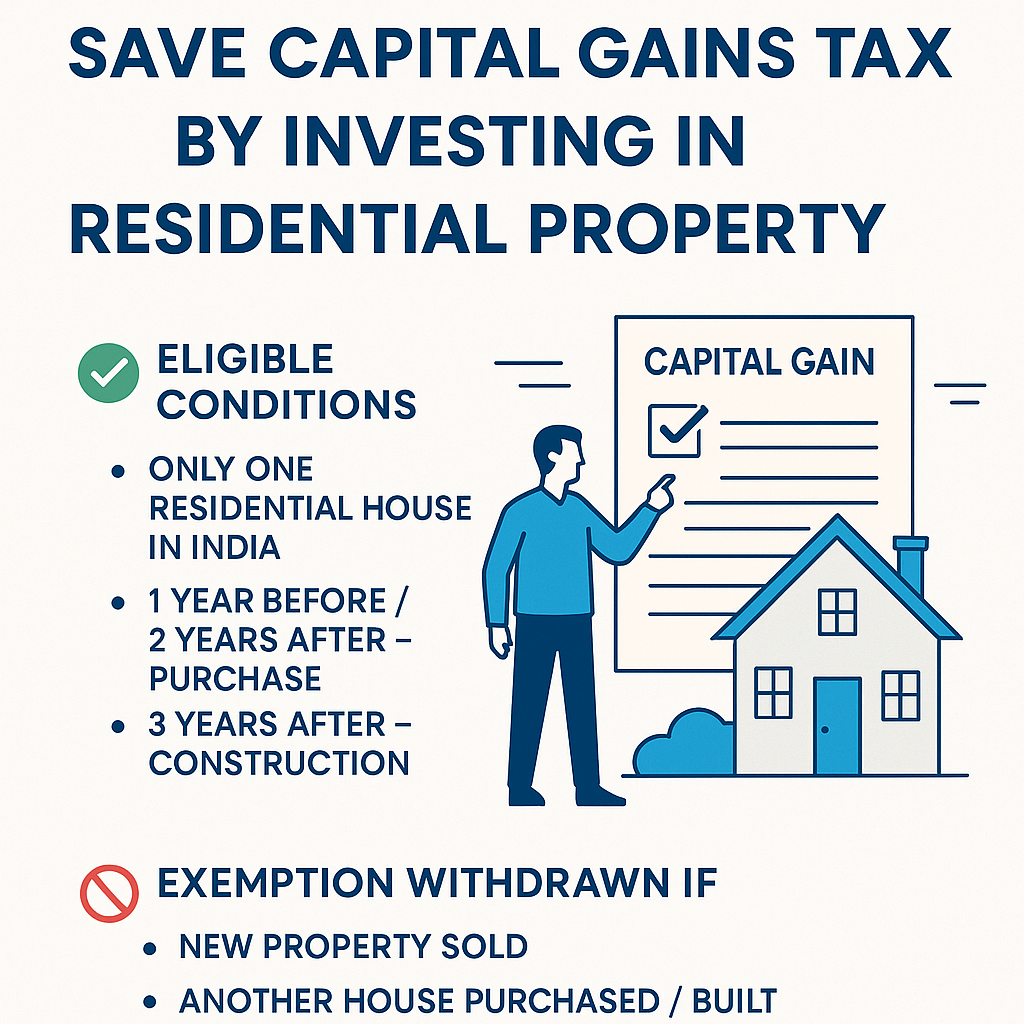
✅ Eligibility Criteria

Available to:

  • Individuals
  • HUFs
  • Non-Resident Indians (NRIs)

Key conditions:

  • The asset sold must be a long-term capital asset, not a residential house.
  • You must not own more than one residential house (excluding the new one) on the date of transfer.
  • The investment must be made in one residential house in India:
    • Purchase within 1 year before or 2 years after the sale, or
    • Construction within 3 years after the sale.
  • The new house must not be sold within 3 years.

📈 How is the Exemption Calculated?

The exemption under Section 54F is proportional to the investment in the new house:

Exemption = LTCG × (Investment in new house / Net sale consideration)

🧮 Example:

  • Net sale consideration = ₹80 lakh
  • LTCG = ₹30 lakh
  • Investment in new house = ₹60 lakh
    ➡️ Exemption = ₹30L × (60L/80L) = ₹22.5L
    ➡️ Taxable LTCG = ₹7.5L

🏦 Capital Gains Account Scheme (CGAS)

If you haven’t utilized the sale proceeds before the due date of ITR filing (usually 31st July), you must:

  • Deposit the unutilized amount in a Capital Gains Account Scheme (CGAS).
  • Use it within the allowed period for purchase/construction.

Failure to do so makes the exemption invalid, and LTCG becomes fully taxable.

🚨 NEW: ₹10 Crore Cap on Exemption

As per the Finance Act, 2023, a cap of ₹10 crore is now placed on exemption under Section 54 and Section 54F, effective AY 2024-25:

Even if you invest more than ₹10 crore in the new house, the maximum exemption is limited to ₹10 crore.

💡 Example with Cap Applied:

  • Net sale consideration = ₹15 crore
  • LTCG = ₹5 crore
  • Investment = ₹12 crore
  • Capped investment = ₹10 crore
    ➡️ Exemption = ₹5 Cr × (10 / 15) = ₹3.33 Cr
    ➡️ Taxable LTCG = ₹1.67 Cr

🌍 Section 54F for NRIs

Yes, NRIs can claim Section 54F, but must follow these:

ConditionNRI Requirement
Asset SoldMust be in India
ReinvestmentOnly in residential property in India
Use of FundsPreferably from repatriated funds
CGASCan be used if not invested before ITR filing

🚫 When is Exemption Withdrawn?

The exemption is revoked and taxed if:

  • The new residential house is sold within 3 years
  • The taxpayer purchases or constructs another residential house within 2/3 years (other than the new one)

In such cases, the earlier exempted capital gain becomes fully taxable in the year of default.

🔚 Conclusion

Section 54F is a powerful tax-saving tool for residents and NRIs alike — especially when you’re planning to reinvest long-term capital gains into residential property. But post Budget 2023, the ₹10 crore cap means high-value investors need careful planning to avoid unexpected tax.


📞 Need Help?

Confused about capital gains tax or reinvestment strategy?

👉 Contact our tax experts today for end-to-end support!