If you’ve sold land, gold, shares, or any long-term capital asset other than a residential house, you may be staring at a large capital gains tax bill. But there’s a smart way to legally save tax — by investing in a residential property under Section 54F of the Income Tax Act, 1961.
In this guide, we’ll cover:
- Who is eligible
- Tax saving through reinvestment
- NRI-specific rules
- New ₹10 crore investment cap
- Tax rate and example calculations
🔍 What is Section 54F?
Section 54F offers exemption from long-term capital gains (LTCG) arising from the sale of assets other than a residential house, if the net sale consideration is reinvested in a residential house property in India.
✅ Eligibility Criteria
Available to:
- Individuals
- HUFs
- Non-Resident Indians (NRIs)
Key conditions:
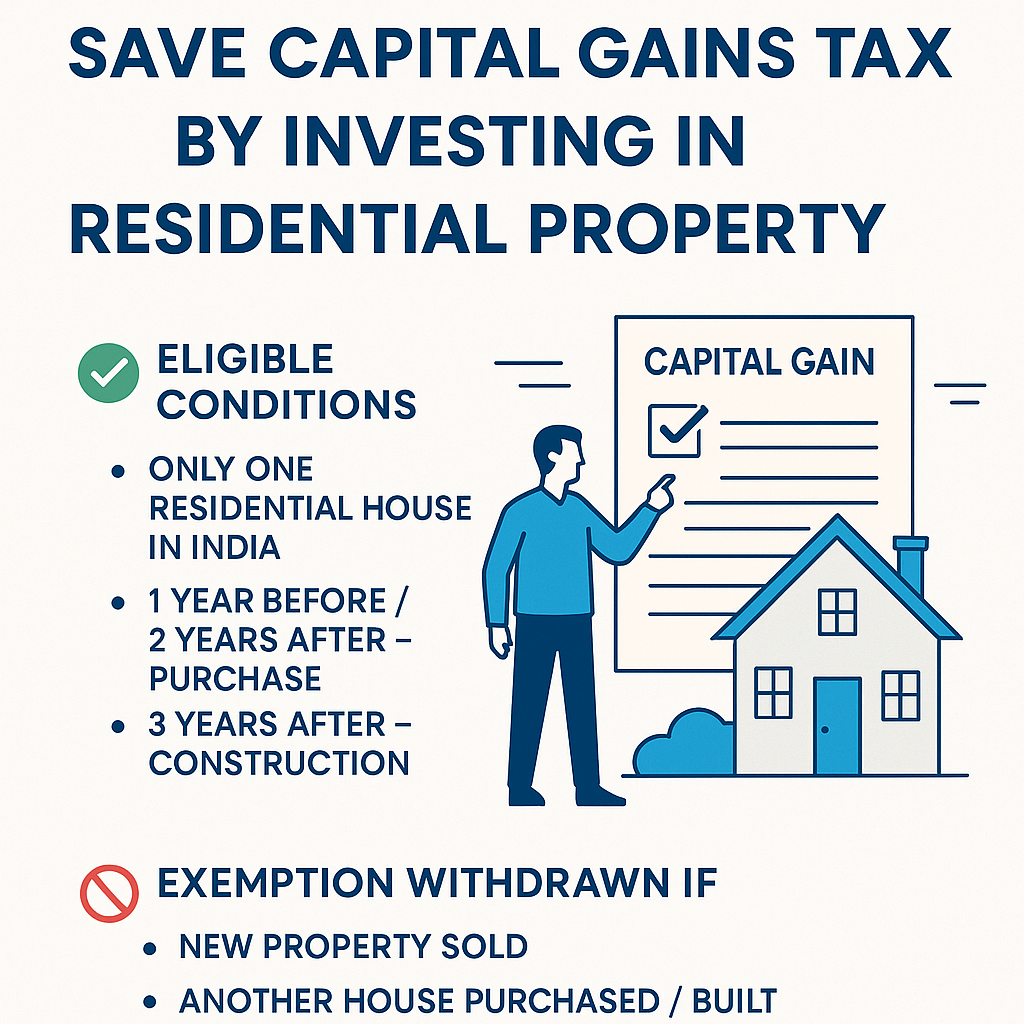
- The asset sold must be a long-term capital asset, not a residential house.
- You must not own more than one residential house (excluding the new one) on the date of transfer.
- The investment must be made in one residential house in India:
- Purchase within 1 year before or 2 years after the sale, or
- Construction within 3 years after the sale.
- The new house must not be sold within 3 years.
📈 How is the Exemption Calculated?
The exemption under Section 54F is proportional to the investment in the new house:
Exemption = LTCG × (Investment in new house / Net sale consideration)
🧮 Example:
- Net sale consideration = ₹80 lakh
- LTCG = ₹30 lakh
- Investment in new house = ₹60 lakh
➡️ Exemption = ₹30L × (60L/80L) = ₹22.5L
➡️ Taxable LTCG = ₹7.5L
🏦 Capital Gains Account Scheme (CGAS)
If you haven’t utilized the sale proceeds before the due date of ITR filing (usually 31st July), you must:
- Deposit the unutilized amount in a Capital Gains Account Scheme (CGAS).
- Use it within the allowed period for purchase/construction.
Failure to do so makes the exemption invalid, and LTCG becomes fully taxable.
🚨 NEW: ₹10 Crore Cap on Exemption
As per the Finance Act, 2023, a cap of ₹10 crore is now placed on exemption under Section 54 and Section 54F, effective AY 2024-25:
Even if you invest more than ₹10 crore in the new house, the maximum exemption is limited to ₹10 crore.
💡 Example with Cap Applied:
- Net sale consideration = ₹15 crore
- LTCG = ₹5 crore
- Investment = ₹12 crore
- Capped investment = ₹10 crore
➡️ Exemption = ₹5 Cr × (10 / 15) = ₹3.33 Cr
➡️ Taxable LTCG = ₹1.67 Cr
🌍 Section 54F for NRIs
Yes, NRIs can claim Section 54F, but must follow these:
| Condition | NRI Requirement |
|---|---|
| Asset Sold | Must be in India |
| Reinvestment | Only in residential property in India |
| Use of Funds | Preferably from repatriated funds |
| CGAS | Can be used if not invested before ITR filing |
🚫 When is Exemption Withdrawn?
The exemption is revoked and taxed if:
- The new residential house is sold within 3 years
- The taxpayer purchases or constructs another residential house within 2/3 years (other than the new one)
In such cases, the earlier exempted capital gain becomes fully taxable in the year of default.
🔚 Conclusion
Section 54F is a powerful tax-saving tool for residents and NRIs alike — especially when you’re planning to reinvest long-term capital gains into residential property. But post Budget 2023, the ₹10 crore cap means high-value investors need careful planning to avoid unexpected tax.
📞 Need Help?
Confused about capital gains tax or reinvestment strategy?