Warning: Array to string conversion in /home/resallerforallot/blog.carupeshmangal.com/wp-content/themes/carupeshmangal/functions/fe/headerdata.php on line 15

Warning: Array to string conversion in /home/resallerforallot/blog.carupeshmangal.com/wp-content/themes/carupeshmangal/functions/fe/headerdata.php on line 15

Warning: Array to string conversion in /home/resallerforallot/blog.carupeshmangal.com/wp-content/themes/carupeshmangal/functions/fe/headerdata.php on line 15

Warning: Array to string conversion in /home/resallerforallot/blog.carupeshmangal.com/wp-content/themes/carupeshmangal/functions/fe/headerdata.php on line 15

Warning: Array to string conversion in /home/resallerforallot/blog.carupeshmangal.com/wp-content/themes/carupeshmangal/functions/fe/headerdata.php on line 15

Warning: Array to string conversion in /home/resallerforallot/blog.carupeshmangal.com/wp-content/themes/carupeshmangal/functions/fe/headerdata.php on line 15

Warning: Array to string conversion in /home/resallerforallot/blog.carupeshmangal.com/wp-content/themes/carupeshmangal/functions/fe/headerdata.php on line 15

Warning: Array to string conversion in /home/resallerforallot/blog.carupeshmangal.com/wp-content/themes/carupeshmangal/functions/fe/headerdata.php on line 15

Warning: Array to string conversion in /home/resallerforallot/blog.carupeshmangal.com/wp-content/themes/carupeshmangal/functions/fe/headerdata.php on line 15

Warning: Array to string conversion in /home/resallerforallot/blog.carupeshmangal.com/wp-content/themes/carupeshmangal/functions/fe/headerdata.php on line 15

Warning: Array to string conversion in /home/resallerforallot/blog.carupeshmangal.com/wp-content/themes/carupeshmangal/functions/fe/headerdata.php on line 15

Warning: Array to string conversion in /home/resallerforallot/blog.carupeshmangal.com/wp-content/themes/carupeshmangal/functions/fe/headerdata.php on line 15

Warning: Array to string conversion in /home/resallerforallot/blog.carupeshmangal.com/wp-content/themes/carupeshmangal/functions/fe/headerdata.php on line 15

Warning: Array to string conversion in /home/resallerforallot/blog.carupeshmangal.com/wp-content/themes/carupeshmangal/functions/fe/headerdata.php on line 15

Warning: Array to string conversion in /home/resallerforallot/blog.carupeshmangal.com/wp-content/themes/carupeshmangal/functions/fe/headerdata.php on line 15

Warning: Array to string conversion in /home/resallerforallot/blog.carupeshmangal.com/wp-content/themes/carupeshmangal/functions/fe/headerdata.php on line 15

Warning: Array to string conversion in /home/resallerforallot/blog.carupeshmangal.com/wp-content/themes/carupeshmangal/functions/fe/headerdata.php on line 15

Warning: Array to string conversion in /home/resallerforallot/blog.carupeshmangal.com/wp-content/themes/carupeshmangal/functions/fe/headerdata.php on line 15

Warning: Array to string conversion in /home/resallerforallot/blog.carupeshmangal.com/wp-content/themes/carupeshmangal/functions/fe/headerdata.php on line 15

Warning: Array to string conversion in /home/resallerforallot/blog.carupeshmangal.com/wp-content/themes/carupeshmangal/functions/fe/headerdata.php on line 15

Warning: Array to string conversion in /home/resallerforallot/blog.carupeshmangal.com/wp-content/themes/carupeshmangal/functions/fe/headerdata.php on line 15

Warning: Array to string conversion in /home/resallerforallot/blog.carupeshmangal.com/wp-content/themes/carupeshmangal/functions/fe/headerdata.php on line 15

Warning: Array to string conversion in /home/resallerforallot/blog.carupeshmangal.com/wp-content/themes/carupeshmangal/functions/fe/headerdata.php on line 15

Warning: Array to string conversion in /home/resallerforallot/blog.carupeshmangal.com/wp-content/themes/carupeshmangal/functions/fe/headerdata.php on line 15

Warning: Array to string conversion in /home/resallerforallot/blog.carupeshmangal.com/wp-content/themes/carupeshmangal/header.php on line 15

Warning: Array to string conversion in /home/resallerforallot/blog.carupeshmangal.com/wp-content/themes/carupeshmangal/header.php on line 15

Warning: Array to string conversion in /home/resallerforallot/blog.carupeshmangal.com/wp-content/themes/carupeshmangal/header.php on line 15

Warning: Array to string conversion in /home/resallerforallot/blog.carupeshmangal.com/wp-content/themes/carupeshmangal/header.php on line 15

Warning: Array to string conversion in /home/resallerforallot/blog.carupeshmangal.com/wp-content/themes/carupeshmangal/header.php on line 15

Warning: Array to string conversion in /home/resallerforallot/blog.carupeshmangal.com/wp-content/themes/carupeshmangal/header.php on line 15

Warning: Array to string conversion in /home/resallerforallot/blog.carupeshmangal.com/wp-content/themes/carupeshmangal/header.php on line 15

Warning: Array to string conversion in /home/resallerforallot/blog.carupeshmangal.com/wp-content/themes/carupeshmangal/header.php on line 15

Warning: Array to string conversion in /home/resallerforallot/blog.carupeshmangal.com/wp-content/themes/carupeshmangal/header.php on line 15

Warning: Array to string conversion in /home/resallerforallot/blog.carupeshmangal.com/wp-content/themes/carupeshmangal/header.php on line 15

Warning: Array to string conversion in /home/resallerforallot/blog.carupeshmangal.com/wp-content/themes/carupeshmangal/header.php on line 15

Warning: Array to string conversion in /home/resallerforallot/blog.carupeshmangal.com/wp-content/themes/carupeshmangal/header.php on line 15

Warning: Array to string conversion in /home/resallerforallot/blog.carupeshmangal.com/wp-content/themes/carupeshmangal/header.php on line 15

Warning: Array to string conversion in /home/resallerforallot/blog.carupeshmangal.com/wp-content/themes/carupeshmangal/header.php on line 15

Warning: Array to string conversion in /home/resallerforallot/blog.carupeshmangal.com/wp-content/themes/carupeshmangal/header.php on line 15

Warning: Array to string conversion in /home/resallerforallot/blog.carupeshmangal.com/wp-content/themes/carupeshmangal/header.php on line 15

Warning: Array to string conversion in /home/resallerforallot/blog.carupeshmangal.com/wp-content/themes/carupeshmangal/header.php on line 15

Warning: Array to string conversion in /home/resallerforallot/blog.carupeshmangal.com/wp-content/themes/carupeshmangal/header.php on line 15

Warning: Array to string conversion in /home/resallerforallot/blog.carupeshmangal.com/wp-content/themes/carupeshmangal/header.php on line 15

Warning: Array to string conversion in /home/resallerforallot/blog.carupeshmangal.com/wp-content/themes/carupeshmangal/header.php on line 15

Warning: Array to string conversion in /home/resallerforallot/blog.carupeshmangal.com/wp-content/themes/carupeshmangal/header.php on line 15

Warning: Array to string conversion in /home/resallerforallot/blog.carupeshmangal.com/wp-content/themes/carupeshmangal/header.php on line 15

Warning: Array to string conversion in /home/resallerforallot/blog.carupeshmangal.com/wp-content/themes/carupeshmangal/header.php on line 15

Warning: Array to string conversion in /home/resallerforallot/blog.carupeshmangal.com/wp-content/themes/carupeshmangal/header.php on line 15
Rupesh Mangal & Associates
Warning: Undefined variable $wpl_ga_code in /home/resallerforallot/blog.carupeshmangal.com/wp-content/themes/carupeshmangal/header.php on line 39

💳 UPI Transactions & ITR Filing: Why Ignoring Them May Invite Income Tax Notices:UPI AND INCOME TAX

India’s digital payment revolution, led by UPI (Unified Payments Interface), has transformed how we transact. But did you know that careless treatment of UPI income can lead to Income Tax scrutiny or notices?

Here’s a detailed breakdown of how UPI affects your ITR and why many taxpayers are being flagged.


📌 Are UPI Transactions Tracked by the Income Tax Department?

Absolutely. UPI is just a payment mode, not anonymous. All UPI transactions go through banks and are monitored as part of your financial activity.

Through SFT (Statement of Financial Transactions) and data integration across platforms, the Income Tax Department cross-checks your income declarations with:

  • UPI credits and debits
  • Bank statements
  • High-value or repeated digital transactions

⚠️ Why People Are Receiving Income Tax Notices for UPI Transactions

Many taxpayers are being sent scrutiny notices because of:

  1. Mismatch of UPI Credits & Reported Income
    If you’re receiving large or regular payments via UPI—whether from clients, customers, tuition, trading, etc.—and haven’t reported this as income, you’re at risk.
  2. Using Savings Account for Business UPI Payments
    If you’re running a business or side hustle and collecting UPI payments into a personal savings account, it raises a red flag.
  3. Receiving Gifts via UPI > ₹50,000
    If you received a UPI gift from a non-relative beyond ₹50,000, it becomes taxable under Section 56(2)(x) unless properly exempted and declared.
  4. Freelance or Side Income Ignored in ITR
    Many salaried individuals ignore UPI credits from side gigs, leading to notices for underreporting income.

🧾 How to Treat UPI Income in Your ITR?

  • Business Income (including via UPI) → Report under Income from Business/Profession
  • Freelance Income / Consultancy via UPI → Use Section 44ADA or regular income head
  • UPI Gifts > ₹50,000 → Report under Income from Other Sources (unless exempt)
  • Reimbursements or Loans → Maintain evidence to avoid misclassification as income

✅ Summary: What Should You Do?

  • 📋 Reconcile your bank & UPI statements before filing ITR
  • 💡 Disclose all receipts—even small ones—if recurring or business-related
  • 🔍 Avoid mixing personal and business UPI flows
  • 💬 When in doubt, consult a tax professional

📌 Final Thought

UPI makes payments easy, but your digital footprint is fully traceable. With advanced analytics, the Income Tax Department flags mismatches quickly. Declaring all UPI-linked income ensures peace of mind and a notice-free ITR.

📞 Need Help?

For further guidance or consultation, feel free to Contact Us or speak with your tax advisor.
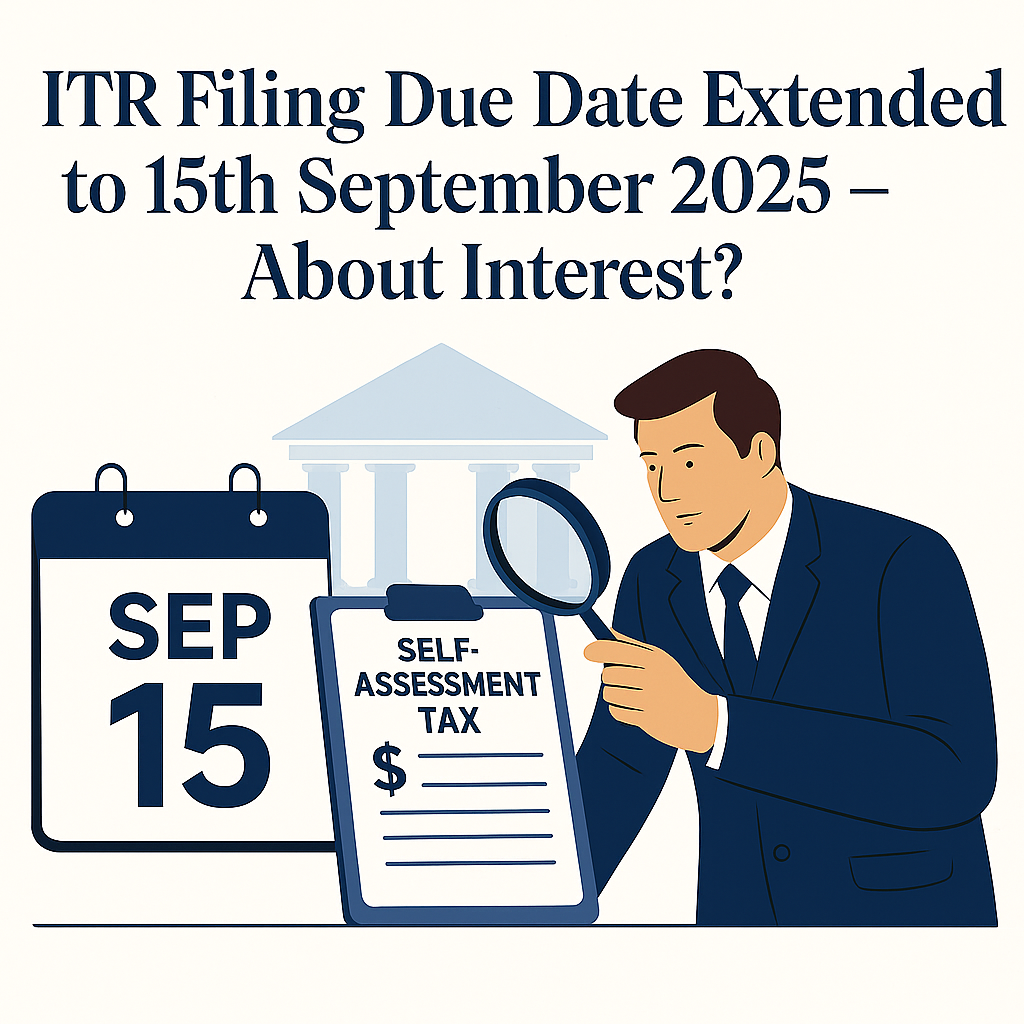
📢 ITR Due Date Extended to 15th September 2025 – What It Means for Advance Tax & Interest Liability

ITR Due Date Extension Featured

The Income Tax Department has extended the ITR filing due date for non-audit taxpayers (individuals & HUFs) from 31st July 2025 to 15th September 2025.

But this extension brings confusion — especially around interest on late tax payments. Let’s break it down simply.

🧾 What Is Advance Tax?

Advance Tax means paying your taxes in parts during the year rather than in one go at year-end. It applies to individuals with tax liability over ₹10,000 after TDS.

🧮 Who Must Pay Advance Tax?

  • Salaried persons with income from other sources (FDs, capital gains, etc.)
  • Freelancers or professionals under Section 44ADA
  • Presumptive income taxpayers under Section 44AD
  • Stock traders or capital gain earners

Senior citizens without business income are exempt.

🗓️ Advance Tax Payment Schedule (FY 2024-25)

Installment Due Date % of Tax
1st 15th June 15%
2nd 15th September 45%
3rd 15th December 75%
4th 15th March 100%

💰 What Is Self-Assessment Tax?

It’s the final tax you pay after year-end when you tally your total income and TDS. Failing to pay this on time invites interest under sections 234A, 234B, and 234C.

⚖️ Breakdown of Sections

  • Section 234A – Interest for delay in ITR filing (starts after 15th Sept 2025)
  • Section 234B – For paying less than 90% of total tax before 31st March (1% interest/month)
  • Section 234C – For late/missed advance tax installments

⚠️ Key Implications

  • ✅ No 234A interest if filed by 15th Sept 2025
  • ❌ 234B and 234C still apply if advance tax wasn’t paid correctly

✅ Summary

  • 📅 ITR due date: 15th September 2025
  • 💡 No 234A interest if filed on time
  • 🔍 234B/234C applicable as per advance tax rules

Need help calculating interest or planning advance tax? 👉 Click here for expert guidance

🚨 High Refunds, Hidden Risk: How You Get Traced by the Income Tax Department


Everyone loves a tax refund. But what if your consultant says:

“Don’t worry, I’ll get you a bigger refund than anyone else!”
“Pay me only when you get the refund!”

🚫 This is a trap — and in most cases, it leads to underreporting income or claiming fake deductions, which may get you flagged by the Income Tax Department (ITD).


⚠️ How Bigger Refunds Often Mean Fraud

Here’s what these refund-based consultants may be doing behind the scenes:

  • Falsely increasing deductions under Section 80C, 80D, or 80G
  • Claiming House Rent Allowance (HRA) without rent receipts or agreements
  • Declaring fake business losses
  • Not reporting other sources of income (like FD interest, capital gains, etc.)

🕵️‍♂️ How You Get Traced by the Income Tax Department

The ITD uses data analytics, PAN-based monitoring, and AIS/TIS matching to catch discrepancies.

🔍 Common Triggers for Scrutiny or Notices:

Mismatch in AIS/TIS vs. ITR
Your AIS includes income like salary, FD interest, stock trades, rent, etc. If anything is missing in your return, it raises a red flag.

Excessive Refund Claims
Unusually high refunds compared to similar profiles often trigger scrutiny.

Random Scrutiny Under CASS
High-risk cases (like high refunds) get auto-selected via AI systems.

Third-Party Reporting
Your banks, employer, mutual fund companies report directly to ITD.

Mismatch in Form 16 or 26AS
Overclaimed deductions or underreported salary? You may get a notice.


📌 The Real Risk: You Are Liable, Not the Consultant

Even if someone else files your return, you are responsible. If misreporting is detected:

  • Notice under Section 139(9), 143(1), 148 or 143(2)
  • Tax + interest + penalty
  • Prosecution in serious cases

⚠️ Past ITRs can be reopened and reassessed too.


✅ What Should You Do?

  • Always review your ITR
  • Don’t trust anyone offering “refund-based fees”
  • Hire ethical, qualified professionals

🔐 Don’t Invite Trouble for a Few Extra Bucks!

🧾 Refund ≠ Reward — it’s just the return of what you overpaid.
💣 Fake refunds = trouble later.


👉 Need ethical, expert guidance on your taxes?
📩 Reach out here


Don’t Risk a ₹10 Lakh Penalty: Why You Must Report ESOPs from Foreign Companies in Your ITR

ITR Filing for Foreign ESOPs
Stay compliant with ITR filing to avoid hefty penalties on foreign ESOPs.

If you’ve received Employee Stock Options (ESOPs) from a foreign company, you might be sitting on a ticking tax time bomb. Failing to report these in your Income Tax Return (ITR) could cost you a hefty penalty of up to ₹10 lakh under the Black Money Act, 2015. Don’t let oversight land you in trouble—here’s everything you need to know to stay compliant and stress-free.

Why Reporting ESOPs from Foreign Companies Matters

Under the Black Money (Undisclosed Foreign Income and Assets) and Imposition of Tax Act, 2015, all Residents and Ordinarily Residents (ROR) of India are required to disclose foreign assets in their ITR, including ESOPs from foreign companies. This disclosure is mandatory in the Foreign Asset Schedule (Schedule FA) of your ITR, even if you haven’t sold the shares or made any capital gains. Simply holding these assets triggers the reporting requirement.

What you need to report:

  • ESOPs and stock options from foreign companies
  • Foreign bank accounts
  • Immovable property held abroad
  • Any other movable foreign assets

Failing to report even a single foreign asset could lead to a staggering ₹10 lakh penalty, regardless of the asset’s value or whether it generated income. The stakes are high, and ignorance is not an excuse.

How You Could Get Caught

Thanks to global information-sharing agreements like the Common Reporting Standard (CRS) and Foreign Account Tax Compliance Act (FATCA), tax authorities worldwide are exchanging financial data automatically. Indian tax authorities cross-check this global data with your ITR. If you miss reporting even one foreign asset—like ESOPs from a foreign employer—you’re likely to get flagged. The consequences? A hefty penalty and potential scrutiny.

Good News: Finance Act 2024 Brings Relief

Starting October 1, 2024, the Finance Act 2024 offers some relief. If the total value of your movable foreign assets (like ESOPs, shares, or bank accounts, excluding immovable property) is below ₹20 lakh, you’re exempt from the ₹10 lakh penalty for non-disclosure. This is a welcome change for small-scale investors or employees holding modest foreign assets. However, you must still report these assets in your ITR to stay compliant.

Who Needs to Report?

The reporting obligation applies to:

  • Residents and Ordinarily Residents (ROR) of India, as defined under the Income Tax Act.
  • Individuals holding foreign assets, even if they haven’t been sold or generated income.

If you’re unsure about your residency status or the value of your foreign assets, consult a tax professional to avoid costly mistakes.

How to Stay Compliant

Here’s how you can avoid penalties and ensure compliance:

  1. File Accurately: Ensure your ITR includes all foreign assets in Schedule FA. Double-check details like the value of ESOPs, foreign bank accounts, or other assets.
  2. Track Your Assets: Maintain clear records of your ESOPs, including grant dates, vesting schedules, and fair market value.
  3. Leverage the ₹20 Lakh Exemption: If your movable foreign assets are under ₹20 lakh, you’re safe from penalties starting October 1, 2024—but you still need to report them.
  4. Seek Expert Help: Tax laws can be complex. A chartered accountant or tax consultant can guide you through the process and ensure compliance.

Why It’s Worth the Effort

Reporting foreign assets might feel like a hassle, but it’s a small price to pay to avoid a ₹10 lakh penalty and potential legal trouble. With global financial transparency on the rise, tax authorities are more vigilant than ever. Stay ahead of the curve by filing your ITR accurately and on time.

Pro Tip: Use tax filing software or consult a professional to streamline the process and ensure you don’t miss any details.

Final Thoughts

The Black Money Act doesn’t play favorites—whether it’s a small ESOP holding or a large foreign investment, non-disclosure can lead to serious consequences. With the Finance Act 2024 offering some relief for smaller asset holders, now’s the perfect time to review your foreign assets and ensure your ITR is compliant. Don’t let a simple oversight cost you ₹10 lakh—file smart, stay safe, and keep your financial future secure.

Note: Always consult a tax professional for personalized advice. This blog is for informational purposes only and does not constitute legal or financial advice.


Income Tax Department raids fake deduction claims under 80GGC, tuition, and insurance. File ITR-U to avoid penalties and stay compliant.


Income Tax Crackdown on Bogus Deduction Claims

🚨 Income Tax Department Raids Bogus Deduction Claims – Here’s What You Need to Know

📰 What Happened?

On July 14, 2025, the Income Tax Department launched multi-city raids targeting individuals and entities involved in facilitating bogus deduction claims under various provisions of the Income Tax Act. These raids focused on:

  • Section 80GGC: Fictitious political donations
  • Medical Insurance Premiums: Inflated or fake claims
  • Tuition Fees: Overstated educational expenses
  • Loan Deductions: Misreported claims under certain categories

These deductions were often filed with the help of intermediaries or unauthorized agents, promising undue tax refunds.

⚠️ Why Did This Happen?

Despite several alerts under the NUDGE initiative, many taxpayers did not act on data mismatch notices. The NUDGE framework uses AI-powered analytics to identify suspicious claims and encourages voluntary correction without penalties. However, non-compliance led to enforcement action.

🧾 What is ITR-U?

ITR-U (Income Tax Return – Updated) allows taxpayers to:

  • ✅ Correct mistakes in previous returns
  • ✅ Avoid penalties and prosecution by filing voluntarily
  • ✅ Stay compliant and reduce audit risks

📊 Key Stats and Trends

  • Over 40,000 taxpayers have filed ITR-U and withdrawn false claims totaling over ₹1,045 crore
  • The department uses AI tools, transaction data, and field intelligence to uncover fraudulent activity
  • Taxpayers are advised to avoid unauthorized refund agents and file genuine claims only

💡 Final Takeaway

If you’ve made inaccurate claims — even unknowingly — filing an ITR-U now is the best safeguard. Honest and accurate reporting helps avoid legal troubles and ensures peace of mind.

🛡️ Proactively filing an ITR-U can protect you from scrutiny and penalties. Don’t wait — act now.

📞 Need Help?

For further guidance or consultation, feel free to Contact Us or speak with your tax advisor.

📢 Big Changes in Capital Gains Tax from July 23, 2024 – What It Means for You!

Starting July 23, 2024, the government has reshaped how India taxes capital gains, especially for equity investors and mutual fund holders. If you’re planning to sell shares, redeem mutual funds, or book profits, these changes directly affect your wallet.


🔄 What Changed?

1. Short-Term Capital Gains (STCG) Tax Hike

  • Old Rate: 15%
  • New Rate: 20%
  • Applicable On: Listed equity shares & equity-oriented mutual funds
  • Effective From: Gains realized on or after July 23, 2024

STCG on other assets (like real estate, gold, etc.) remains taxed as per applicable slab or flat rates.

2. Long-Term Capital Gains (LTCG) Tax Tweaked

  • Old Rate: 10%
  • New Rate: 12.5%
  • Applies To: Listed equity shares, equity mutual funds, business trusts
  • Exemption Limit: Increased from ₹1 lakh → ₹1.25 lakh per year

This change offers limited relief, but the higher tax rate may still lead to higher outflows.

3. Indexation Benefit Removed

Earlier, indexation helped reduce taxable LTCG by adjusting the purchase cost for inflation. That benefit is now removed across the board for all long-term capital assets, including:

  • Debt mutual funds
  • Real estate
  • Gold
  • Unlisted shares

This makes long-term holding slightly less tax-efficient, especially for high-inflation assets.


💥 What’s the Impact?

  • Higher Tax Outgo for Investors: Profit-booking will now cost more, especially for large portfolios.
  • Less Favorable for Long-Term Debt Investors: Removal of indexation hits real estate and debt funds hardest.
  • Simpler But Costlier: Tax filing is easier now—but not cheaper.

🧠 What Should You Do?

  • Review your portfolio and re-evaluate short-term sell decisions.
  • Reconsider holding periods to balance taxes and returns.
  • Consult a tax expert if planning major exits post-July 2024.

🧾 Final Word

This mid-year change is a bold move—aiming for simplicity but at the cost of investor-friendliness. As always, staying informed and planning smartly is your best bet!


🔍 Need personalized tax advice?
📞 Contact us today for 1-on-1 consultancy or clarification.